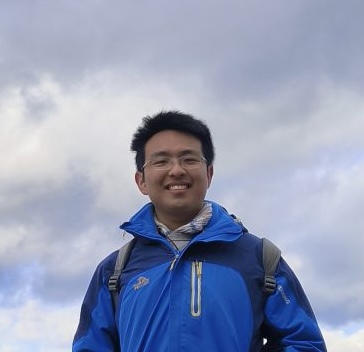
I am a PhD student at the Georgia Institute of Technology (Georgia Tech). I am working with Prof. Qi Tang @ Georgia Tech on computational plasma physics.
During my undergraduate studies, I was fortunate to work with Prof. Hao Chen @ HKUST on deep learning-based medical image analysis, and our work was proudly published at CVPR. I also had the privilege of collaborating with Prof. Robert Katzschmann @ ETH on deep learning-based surrogate modeling for transient fluid-structure interaction and with Prof. Fu Lin @ HKUST on data-driven airfoil optimization.
My research interest lies in high-performance computing, scientific modeling and simulation, and artificial intelligence for scientific computing.
News
- 2026.09 Our latest work, Structure-preserving Transfer of Grad-Shafranov Equilibria to Magnetohydrodynamic Solvers, was accepted by the Journal of Computational Physics.
- 2025.09 Our latest work, Structure-preserving Transfer of Grad-Shafranov Equilibria to Magnetohydrodynamic Solvers, was presented at MFEM Community Workshop 2025.
- 2025.04 I has been selected to attend the 13th Argonne Training Program on Extreme-Scale Computing (ATPESC), hosted by Argonne National Laboratory. I was chosen from over 200 applicants to receive full travel support.
- 2025.04 I have been selected to attend the NSF sponsored structure-preserving scientific computing and machine learning summer school and hackathon.
- 2024.08 I graduated from the Hong Kong University of Science and Technology, and became a PhD student at the Georgia Institute of Technology.
Publications
DoNet: Deep De-Overlapping Network for Cytology Instance Segmentation
Hao Jiang*, Rushan Zhang*, Yanning Zhou, Yumeng Wang, Hao Chen
Google Scholar | Paper | Code |
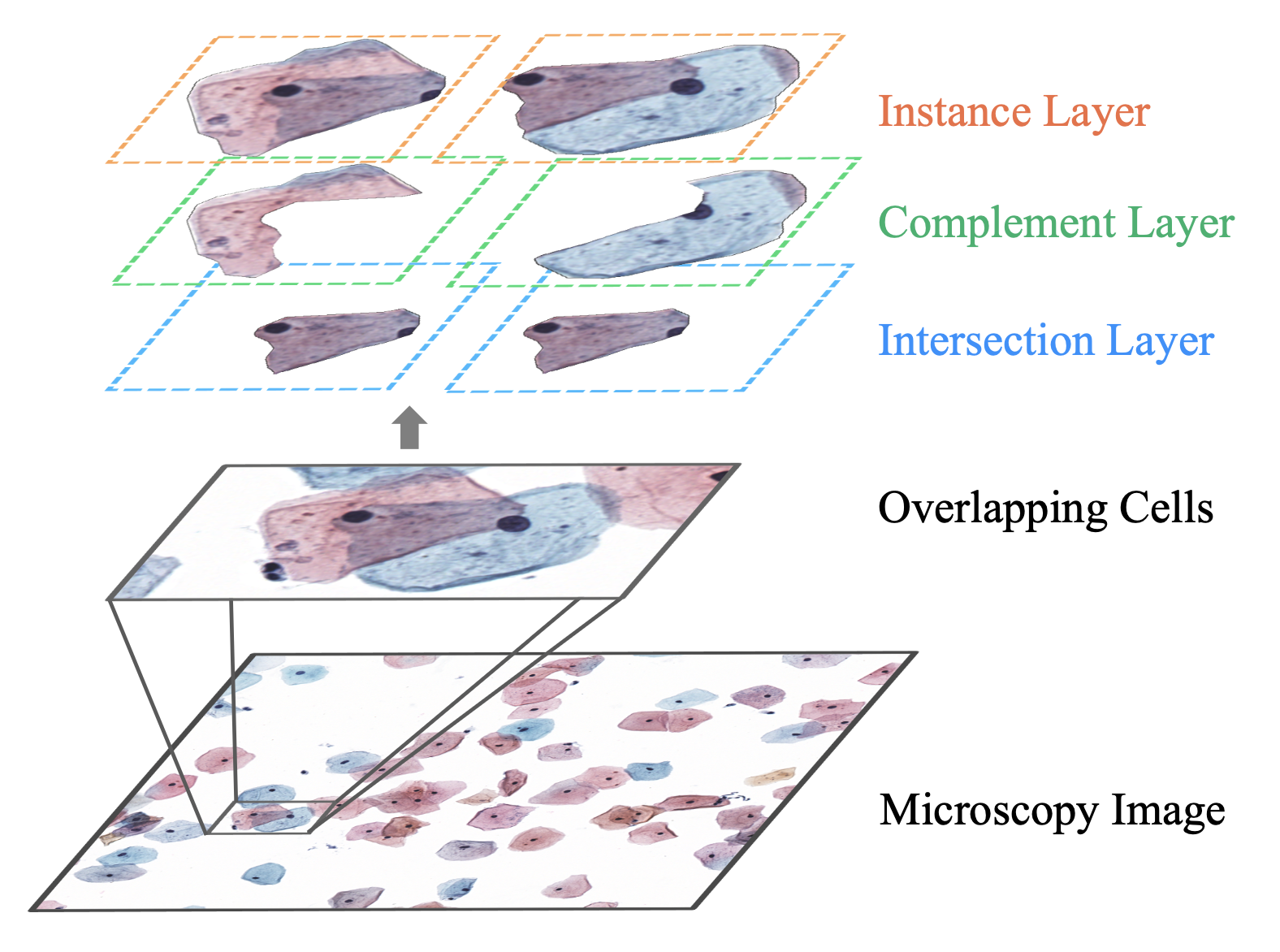
- In this work, we proposed a De-overlapping Network (DoNet) in a decompose-and-recombined strategy. A Dual-path Region Segmentation Module (DRM) explicitly decomposes the cell clusters into intersection and complement regions, followed by a Semantic Consistency-guided Recombination Module (CRM) for integration. To further introduce the containment relationship of the nucleus in the cytoplasm, we design a Mask-guided Region Proposal Strategy (MRP) that integrates the cell attention maps for inner-cell instance prediction. We validate the proposed approach on ISBI2014 and CPS datasets. Experiments show that our proposed DoNet significantly outperforms other state-of-the-art (SOTA) cell instance segmentation methods.
Structure-Preserving Transfer of Grad-Shafranov Equilibria to Magnetohydrodynamic Solvers
Rushan Zhang, Golo Wimmer, Qi Tang
Google Scholar | Paper | Code | Presentation |
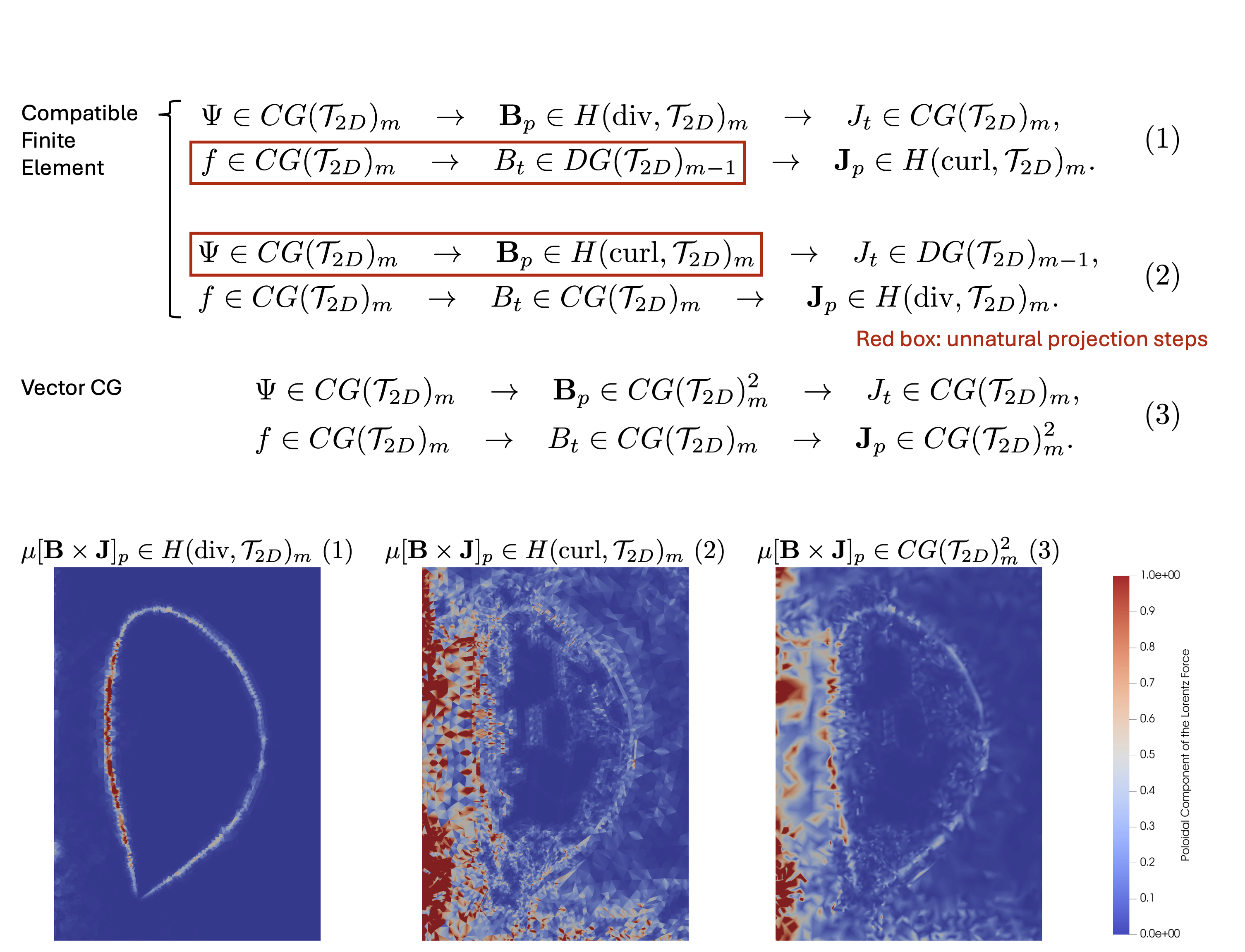
- Magnetohydrodynamic (MHD) simulations of magnetically confined plasmas require initial conditions that satisfy force balance, typically obtained from equilibria computed by Grad–Shafranov (GS) solvers. However, transferring these equilibria to MHD discretizations can introduce numerical errors that disturb the equilibrium. This work identifies and analyzes key error sources within finite element frameworks, focusing on the preservation of force balance and the divergence-free property of the magnetic field. We show that errors primarily arise from (1) incompatible finite element spaces between GS and MHD solvers, (2) mesh misalignment, and (3) under-resolved gradients near the separatrix. Using numerical experiments, we demonstrate that equilibria are best preserved when structure-preserving finite element spaces are employed, meshes are aligned and refined, and magnetic fields are projected into div-conforming spaces to maintain force balance. Projection into curl-conforming spaces, while less optimal for force balance, provides weak preservation of the divergence-free condition.
Educations
- 2024.08 - Present The Georgia Institute of Technology (Georgia Tech)
- PhD in Computational Science and Engineering
- 2024.08 - 2026.08 The Georgia Institute of Technology (Georgia Tech)
- MS in Mathematics
- 2020.09 - 2024.06 The Hong Kong University of Science and Technology (HKUST)
- BEng in Aerospace Engineering and BSc in Computer Science
- Awardee of the Academic Achievement Medal (Top 1%)
- 2022.08 - 2022.12 The Georgia Institute of Technology (Georgia Tech)
- Exchange Student
Academic Trainings
- 2025.08 Argonne Training Program on Extreme-Scale Computing (ATPESC) 2025
- Hosted by the Argonne National Laboratory
- 2025.06 Structure-Preserving Scientific Computing and Machine Learning Summer School and Hackathon
Honors and Awards
- 2024.11 The Hong Kong University of Science and Technology Academic Achievement Medal (Top 1%)
Previous Projects
- 2023.09 - 2024.06 Designing a high-performance airfoil by advanced CFD and machine-learning methods (Prof. Fu Lin@HKUST, Final Year Design Project for Aerospace Engineering)
- Designing, implementing and evaluating machine-learning-based methods for airfoil shape optimization, and comparing results with numerical adjoint methods and experimental results
- Inspiration:
- Machine learning methods excel in identifying coarse global optima, while numerical adjoint methods excel in refining local optima
- Combining these two methods could potentially yield improved results
- 2023.09 - 2024.06 Adversarial or reinforcement learning-based closed-loop training strategy for PINN-based fluid simulators that generalize (Prof. Dit-Yan YEUNG@HKUST, Final Year Project for Computer Science)
- Designing, implementing and evaluating a closed-loop training strategy for PINN-based fluid simulator with adversarial or reinforcement learning, to achieve enhanced generalizability
- Inspiration:
- Closed-loop strategy can more efficiently explore the solution space
- Training strategies like RL and AL can be used to form a closed-loop process
- 2023.06 - 2023.08 Iterative surrogate model optimization for transient fluid structure interaction (Prof. Dr. Robert Katzschmann@ETH Zurich, Summer Research Internship)
- Designing, implementing and evaluating surrogate models for fluid structure interaction, conducting optimization with the resultant surrogate models
- Inspiration:
- Modeling transient fluid flow as a Markov process to enable single-step prediction of flow evolution
- Introducing shape representation from the field of computer vision to enable monolithic modeling of fluid-structure interaction
- Introducing active learning techniques to reduce the number of samples required for optimization
- 2022.02 - 2023.08 Deep learning for medical image analysis (Prof. Chen Hao@HKUST, Undergraduate Research Opportunity Program)
- Designing, implementing and evaluating a novel de-overlapping strategy for semi-transparent cervical cell segmentation
- Inspiration:
- Using extra information from the overlapping area and the non-overlapping area to guide the segmentation of the whole cell
- Publication: CVPR2023: DoNet: Deep De-overlapping Network for Microscopy Instance Segmentation
- 2021.06 - 2021.09, Digitalization of wet lab project (WeShare Tech Limited, Student Helper)
- Implementing the hazard warning feature with pop-up windows
- Role:
- Front-end development with Vue.js
Talks
- 2025.09 Structure-preserving Transfer of Grad-Shafranov Equilibria to Magnetohydrodynamic Solvers (Slides)